In Ramadan I was a different man. Up before fajr without an alarm fight. Salaah on time, not squeezed in at the last edge of the window. Qur’aan in the car instead of voice notes. The whole month runs on a rhythm somebody else sets for you, and you start to believe the rhythm is yours.
Then Eid comes, the scaffolding is taken away, and you find out how much of it you were actually holding up yourself.
It is five months later. I am not going to pretend the momentum survived. And here is the part I have been sitting with: it did not disappear in a dramatic way. I never once decided to skip a salaah. What happened is smaller and more embarrassing than that. I deferred. I told myself I would catch it after this meeting, after this shoot, once I am back at the house. And the reason was almost never spiritual. It was logistics.
Nine times out of ten, it was wudhu.
The excuse nobody says out loud
If you work outside your home, you know the moment. Salaah time is closing in and the only water in reach is a public bathroom you would rather not put your feet anywhere near. So you improvise. You balance on one leg at a basin. You wet a sleeve. You take a bottle into a cubicle and hope nobody walks in on you. Or you look at all of that, decide it is too much admin, and tell yourself later.
Later does not always come.
It is a small friction. It is also a daily one, five times over. And small daily frictions are exactly how good habits die, because they never present themselves as a spiritual failure. They present themselves as an inconvenience, which is much easier to accept.
I have spent twenty years in media watching brands fail for the same reason. Nobody quits because of a big dramatic problem. They quit because something was mildly annoying every single day and nobody bothered to remove it.
What is sitting on my desk
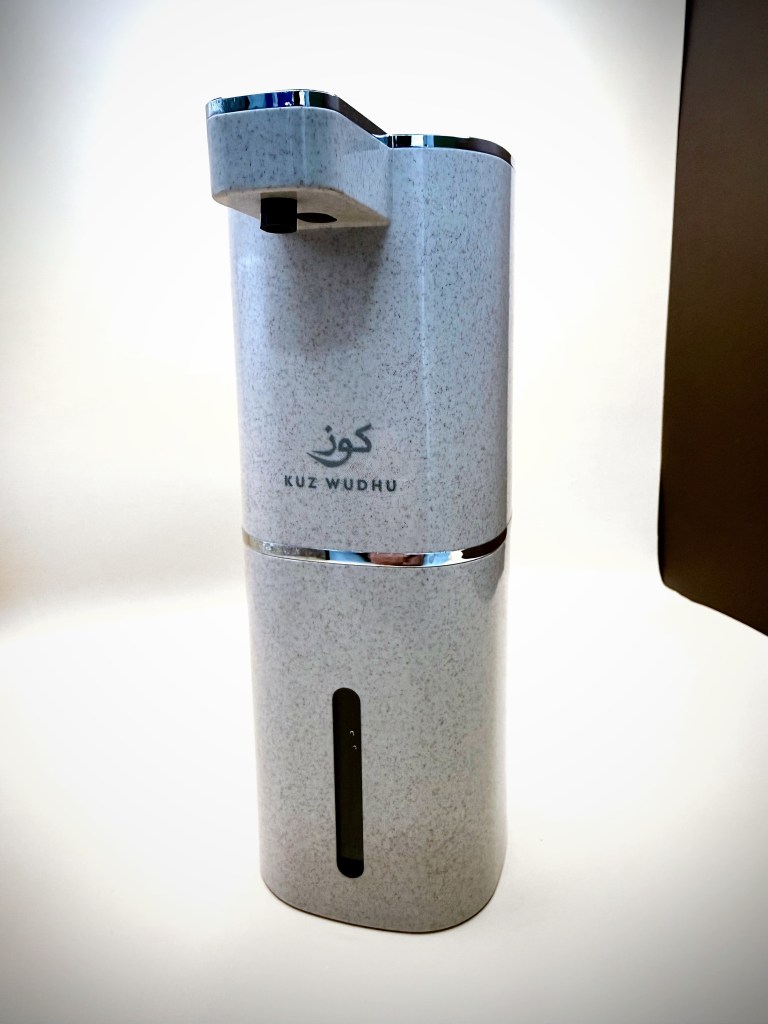
A Kuz Wudhu, still in the box.
It is a 420ml water tank in a body small enough for a bag or a car door pocket. Instead of a spout you tip, it has a motion sensor. You wave a hand underneath and it releases a controlled stream, hands free, at one of four flow settings. Fill it at any tap, keep it with you, make wudhu wherever salaah finds you. It charges over USB. One tank is meant to cover a full wudhu with room to spare, in the spirit of using little water.
It sells for R1,499 for a single unit, less per unit if you buy two or three, and the brand is South African and Muslim-owned, shipping worldwide, with a donation attached to every purchase.
I have not used it yet. That is deliberate, and it is the whole reason I am writing this before rather than after.
Why I am doing it in this order
I did not buy a gadget. I removed an excuse.
That distinction matters to me, because the way most of us try to fix a habit is by applying more sincerity. More niyyah, more guilt, more promises after Jumuah. It almost never works, and then we conclude the problem is our iman. Usually the problem is a basin.
So I am going to run this properly and in public. I am going to film the series as I go: what I lost after Ramadan, one thing at a time, starting with this one. I will show you whether it actually holds through September, October and November, which for me is the heaviest work stretch of the year and therefore the only honest test there is. If it does not work, I will say that too. A series where everything goes well is not a series, it is an advert.
Two things I want to be clear about.
First, I am not a scholar and I do not hand down rulings. The brand’s own position is that a wudhu made this way is valid because clean water flows over the limbs. That reasoning sounds sensible to me, but if it matters to you, and it should, ask your own imam or your local ulama body before you spend a cent. It is a two minute conversation.
Second, the thing I am testing is not really the product. It is whether removing one piece of friction is enough to restore one habit. The device is just the variable I changed.
The wider thing worth noticing
While we were all talking about the halaal economy as if it begins and ends with meat, South African Muslim founders quietly started building for a global niche market from Joburg and Durban and Cape Town, and shipping it worldwide. It is finance, travel, cosmetics, logistics, media, and yes, a sensor tap you keep in your handbag because somebody looked at a daily inconvenience everyone had accepted and decided it did not have to stay that way.
That instinct is worth more than the gadget.
I am tracking the next thirty days on TikTok, starting with this. If you also came out of Ramadan strong and quietly lost it somewhere around April, follow along. You are not the only one.

Leave a comment